Strategy 5
Track 1

Transforming Indigenous Legal Aid Services

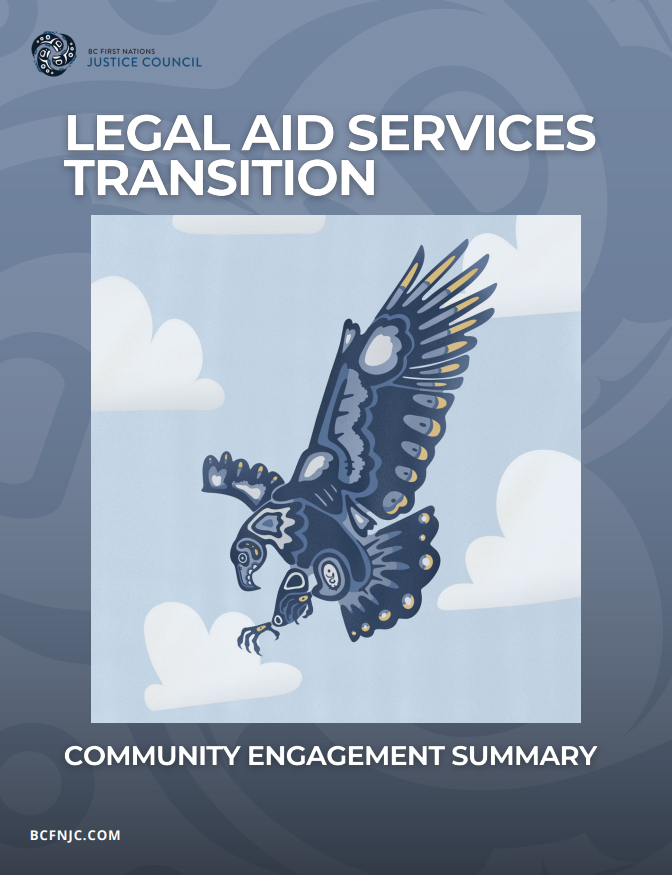
Illustration from Austin Harry

Transferring Indigenous legal aid services to BCFNJC and developing a legal aid model that will increase access to justice and culturally safe services for Indigenous accused.

The Challenge

Legal Aid BC is a provincial Crown Corporation created by the Legal Services Society (LSS) Act in 1979 to provide legal information, advice, and representation services. Currently, most Indigenous people only have access to the legal aid services provided through Legal Aid BC. For many years Indigenous people have advocated for the transformation of legal aid services in BC due to broad and systemic concerns around its administration and funding. There are also concerns related to the availability and accessibility of legal aid for Indigenous accused with evidence demonstrating these challenges are even more intense in rural areas where, in some regions, up to 90% of legal aid clients are Indigenous. The current status quo of legal aid is a factor contributing to overincarceration and raises critical questions about how fundamental civil and legal rights guaranteed in the Canadian Charter of Rights and Freedoms may not be upheld for Indigenous accused.

The Solution

To achieve this transformation, BCFNJC will work in partnership with the BC and Legal Aid BC to transfer legal aid services for Indigenous people to BCFNJC. Through Strategy 5, BCNJC will develop and administer an innovative and holistic model of legal aid that reflects the need for better, more effective, more culturally informed legal counsel and legal aid services for Indigenous people dealing with the criminal justice system.


Line of Action

(1)
A
BCFNJC and BC will develop a workplan to transition legal aid services for Indigenous people in BC from Legal Aid BC to an Indigenous-controlled entity.
Status in-progress

Timeline

Jan. 2022
Transition of Legal Services Working Group created

BCFNJC, the Province of BC and Legal Aid BC established a Transition of Legal Services Working Group to explore potential models of legal aid service delivery for Indigenous peoples in B.C.

Feb. 2022
Memorandum of Understanding signed with Legal Aid BC

BCFNJC signed a Memorandum of Understanding with LABC to establish a collaborative relationship to develop a plan to transfer responsibility for the delivery of legal aid services for Indigenous peoples to BCFNJC.

Feb. 2023
Preliminary research paper was prepared

The paper, BC First Nations Justice Council Legal Services: Legal Aid Transition Preliminary Research, explores the history and evolution of legal aid for Indigenous people in Canada, the the current state of legal aid for Indigenous peoples in British Columbia, and  best practices from other jurisdictions.

Research Paper
March 2023
Feedback gathered at Justice Forum

The 3rd Annual Justice Forum offered the first opportunity for feedback on the current and future state of legal aid services for Indigenous people in B.C. A breakout session, Legal Aid: Indigenous Justice Centres and Gladue, was held on March 7, 2023.

What We Heard
July 2023
Phased approach developed

BCFNJC developed a phased approach to transition legal aid services for Indigenous people from LABC:

  • Phase 1: Research, Pre-Engagement and Team Development
  • Phase 2: Province-wide Engagement
  • Phase 3: Model Development and Further Engagement
  • Phase 4: Finalize Model, Pilot Components of the Model, Further Engagement and Develop Implementation Plan
  • Phase 5: Implementation of Model
Fall 2023
In-person engagements sessions held

BCFNJC held 18 in-person community engagement sessions and 17 legal professional engagement sessions, across B.C. Locations were selected based on proximity to the greatest number of First Nations, Métis Charted Communities, IJCs, First Nations Court, Circuit Courts, Parents Legal Centers and other community service providers.

Community Engagement Summary
Nov. 2023–Jan. 2024
Virtual engagement sessions held

BCFNJC held four virtual engagement sessions in November 2023, and compiled feedback from all engagement sessions (in-person and virtual) to develop 44 recommendations. Key themes from the feedback:

  • Holistic and wraparound supports
  • Community collaboration and relationship building
  • Cultural competency and trauma-informed services
  • Expanding legal services
44 Recommendations
Spring 2024
Community Engagement Summary released

The report, Legal Aid Services Transition: Community Engagement Summary, presents feedback gathered at the 3rd annual justice forum, through in-person and virtual engagements, and through an online survey.

Engagement Summary